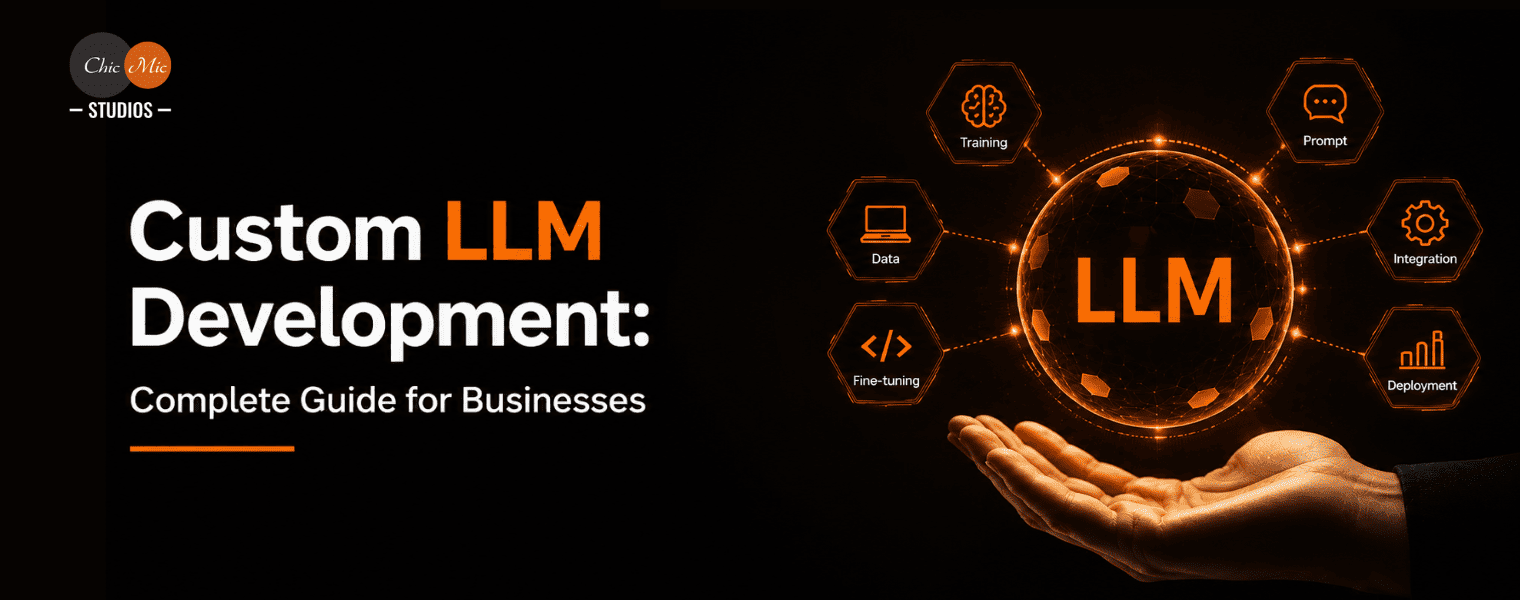
Custom LLM Development: Complete Guide for Businesses
Key Takeaways
- Custom LLM development helps businesses move beyond generic AI tools by creating secure, domain-specific AI systems aligned with their workflows, data, and compliance needs.
- Enterprises invest in custom LLMs to improve operational efficiency, automate repetitive tasks, strengthen data privacy, and gain long-term competitive advantage through proprietary AI capabilities.
- Successful custom LLM projects begin with clear business use cases, followed by structured data preparation, model selection, testing, deployment, and continuous optimization.
- Enterprise-grade custom LLMs offer advanced capabilities such as domain-specific knowledge, workflow integration, role-based access controls, brand-aligned communication, and continuous learning.
- Industries including finance, healthcare, legal, e-commerce, SaaS, and enterprise operations benefit significantly from custom LLMs for tasks like compliance review, contract analysis, customer support, and knowledge retrieval.
- Compared to off-the-shelf AI models, custom LLMs provide stronger privacy, better domain accuracy, deeper enterprise integrations, and greater control over intellectual property and scalability.
- The future of custom LLM development is moving toward agentic AI workflows, multimodal intelligence, smaller proprietary models, federated learning, and continuously fine-tuned enterprise AI systems.
Introduction
In 2026, Custom LLM Development is becoming a strategic goal as organizations migrate from generic AI tools to private, domain-specific systems that understand their data, workflows, clients and regulatory obligations. This transition is a key inflection point for CTOs, VPs of Engineering and innovation executives alike, as AI evolves from a simple productivity tool to a core organizational competency supported by safe architecture, workflow automation and an overarching long-term AI strategy. Organizations that embrace this change can benefit from structured custom AI development services that tie LLM solutions to real-world business outcomes.
As AI becomes embedded in core business processes, generic models often fall short in areas like accuracy, privacy, governance and depth of integration. An effective strategy can help organizations to make use of proprietary data to gain a competitive edge, mitigate operational risk, enhance decision making, and embed AI in their existing web, mobile app development, and enterprise software frameworks.
For businesses still evaluating AI adoption, understanding why AI is the future of enterprise app development can help connect custom LLM investments with long-term digital transformation goals.
What Is Custom LLM Development?
Custom LLM development is the creation of a large language model designed, trained, fine-tuned, deployed, and optimized to a company’s specific data, workflows, industry terminology, regulatory requirements, and business goals. Organizations build AI systems that understand internal documents, customer journeys, product logic, operational rules, and domain-specific vocabulary, rather than relying on general instructions.
By moving from generic AI tools to customized large language model solutions, enterprises can build models that work well in their real operational environment. A custom LLM can have private knowledge retrieval, fine-tuning, enterprise APIs, access controls, safety mechanisms, ongoing monitoring. ChicMic Studios’ AI development services and generative AI solutions are a solid base for enterprise-level AI systems for enterprises that are going down this path. Teams comparing model customization approaches can also explore fine-tuning vs prompt engineering to decide when a simple prompt layer is enough and when deeper LLM customization is required.
An LLM is truly “custom” when it is more than simple prodding. Prompting influences the responses, while enterprise LLM customisation governs the model’s accessibility, response mechanisms, supported workflows, and performance evaluation criteria. Custom LLMs are especially appealing to industries like healthcare, banking, legal, insurance, SaaS, or corporate assistance and in mobile, web, and AI chatbot development processes. Since enterprise models must reason over business context rather than simply repeat stored information, it is useful to understand the difference between LLM reasoning and memorisation before designing production workflows.
Why Businesses Invest in Custom LLMs
Companies develop custom LLMs because off-the-shelf AI tools lack the accuracy, privacy, and domain knowledge required to manage high-value company operations.
Improved ROI for all workflows
Custom LLMs reduce manual work, increase response time and help teams automate repetitive processes in support, legal, sales and operations.
Higher barrier to competition
A sophisticated LLM for business offerings leverages proprietary data and workflows, converting internal know-how into an AI asset that rivals can’t easily copy.
Better Data Privacy and Governance
Custom LLMs can be deployed on private cloud infrastructure, with access controls, encryption, and audit logs. The NIST AI Risk Management Framework is an important reference for artificial intelligence governance.
Better Accuracy in Domains
A leading US telehealth provider is considering a HIPAA-compliant, custom LLM for patient intake, care note summarization, appointment scheduling, and policy-driven assistance. Accuracy-focused AI systems should also account for hallucination risks, which mak es AI hallucination prevention an important part of enterprise LLM planning.
Enhanced Security for Enterprise AI Solutions
Custom LLMs allow you to build secure, scalable AI for regulated and customer-facing goods, especially when integrated with healthcare software solutions, machine learning development, and custom web application development.
The Custom LLM Development Process
A successful custom LLM starts with business insights, not model training. Before development begins, the procedure needs to define the use case, data environment, users, risks and success indicators. Thus, the final solution is accurate, safe, scalable, and applicable to real enterprise workflows.
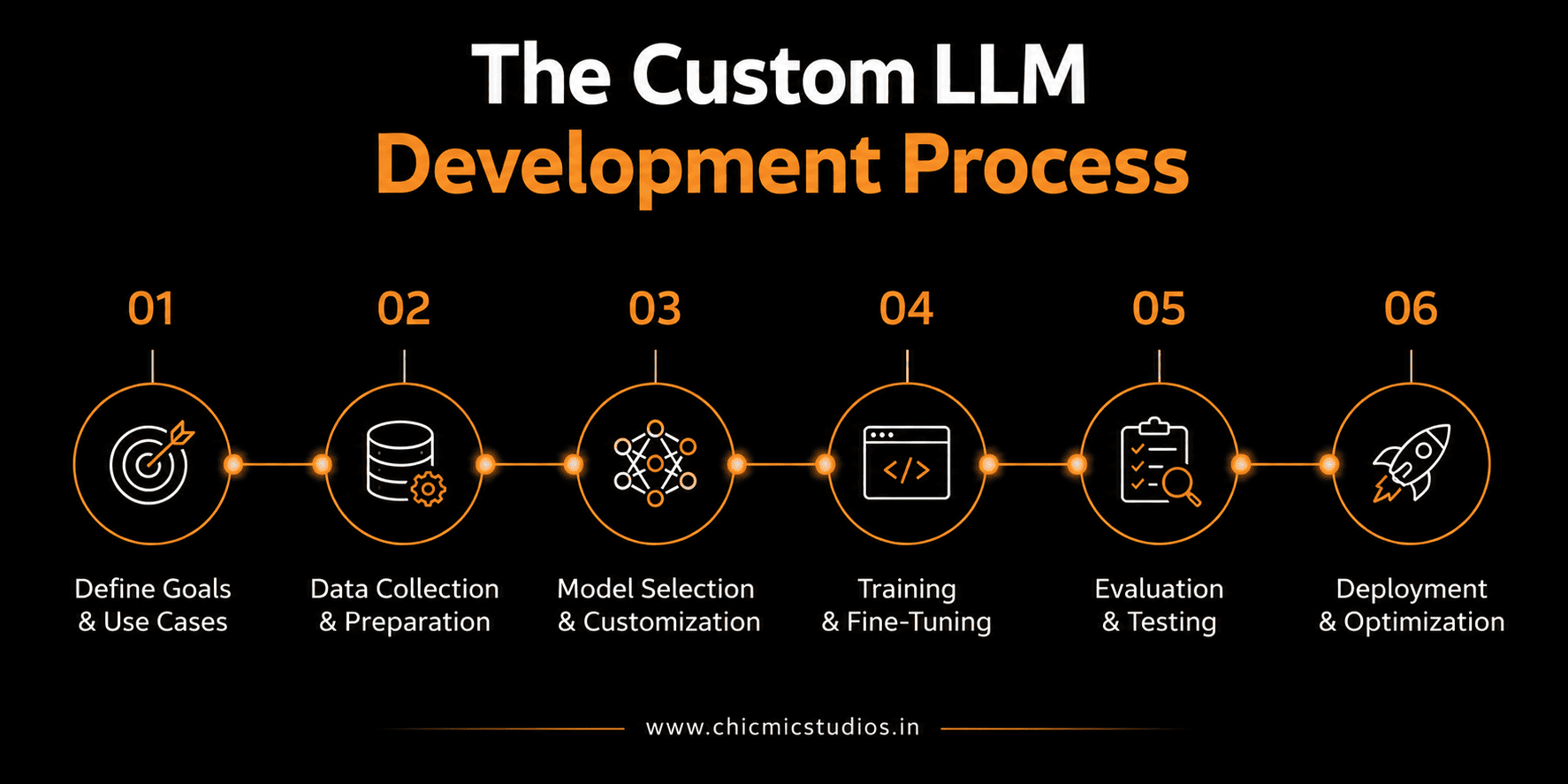
- Use Case Identification and Specification
Teams determine the use cases where the custom LLM can add the most value, such as customer support automation, internal information retrieval, legal review, clinical workflow support, sales enablement or compliance assessment.
- Data Curation and Preparation
The quality of the data directly affects the performance of the model. They gather, clean, structure, and classify sources such as PDFs, CRM records, support requests, policy documents, contracts, product catalogs, internal wikis, and APIs. External resources such as Google Cloud Vertex AI Fine-Tuning and AWS Bedrock Fine-Tuning describe how model customisation can improve performance for specific tasks.
- Model Selection, Design and Training
This step defines the architecture and design of the LLM. The choice of RAG, fine-tuning, vector search, prompt orchestration, multi-agent workflows, or a hybrid configuration. The right foundation model is selected based on precision, cost, latency, hosting requirements, compliance and scalability. A strong model strategy also depends on understanding the key technologies powering modern AI systems, including foundation models, data pipelines, retrieval systems, and deployment infrastructure.
- Assessment, Protections And Testing
Evaluating LLMs’ performance is an important best practice. The model is evaluated on real-world queries, edge cases, data-scarce scenarios, and compliance-sensitive prompts. For regulated or customer-facing use cases, businesses should treat responsible AI adoption as a core requirement, not a post-launch concern.
- Deployment and Continued Improvement
Once validated, the LLM can be integrated into CRMs, ERPs, helpdesk tools, document systems, databases, web platforms, mobile apps or cloud infrastructure. Teams evaluate accuracy, latency, costs, adoption, feedback, and risk signals after launch.
Build Your Custom LLM with ChicMic Studios – Move beyond generic AI. Our team designs and deploys bespoke LLMs that unlock competitive advantage. Start Your Project
Key Features of a Custom LLM
Enterprise-grade bespoke LLMs are designed to do more than just text generation. They are built around business context, security, work flows and sustained performance. The most powerful custom AI language models for enterprises blend domain expertise with seamless integration to provide teams with an AI system that understands how the organization operates.
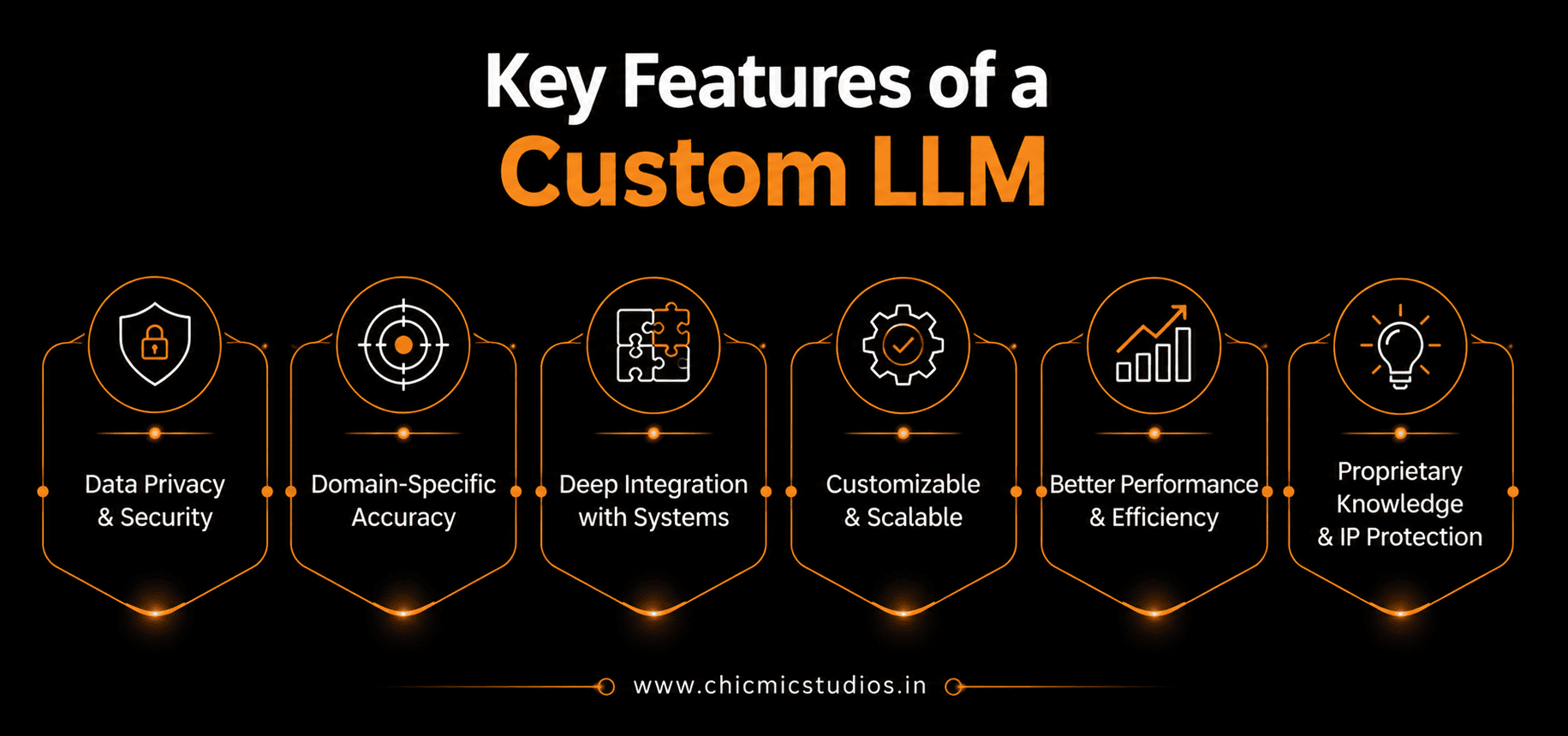
- Domain-Specific Knowledge
You can train a custom LLM on, or base it off of, proprietary documents, regulations, product information, support records, contracts and industry-specific vocabulary. This allows the model to generate more accurate answers than generic tools, particularly in banking, healthcare, legal, SaaS, and corporate support scenarios. Large enterprise use cases also depend on how much context a model can process, making AI context windows important for document-heavy workflows such as legal review, support, and compliance.
- Data Security and Access Control
Security is a fundamental component, not an add-on. Custom LLMs can offer private deployment, encryption, role-based access, audit logs, data masking, and compliance-oriented procedures. This is especially important when models deal with customer data, legal records, financial records, or protected health data.
- Brand and Communication Alignment
A custom LLM can be tuned to the organization’s tone, vocabulary, support standards, compliance language and customer experience protocols. This makes sure that AI-generated responses are on-brand, and not generic or disjointed.”
- Workflow Integration
Optimization of LLM for workflows is a major contributor of enterprise value. Custom LLMs can plug in to CRMs, ERPs, helpdesk tools, internal databases, document systems, mobile apps and web platforms to give real business results, not just conversations.
- Continuous Learning and Improvement
Custom LLMs can be improved by feedback loops, updated knowledge bases, performance evaluations, and retraining cycles. The proprietary LLM models become more and more useful as they learn the enterprise-specific procedures, user behavior, and approved data sources.
Enterprise Use Cases for Custom LLMs
Custom LLMs are most valuable when applied to specific business problems in regulated, data-rich, or customer-facing industries. An effective corporate AI strategy will help companies turn personalized large language model solutions into concrete bottom line improvements in productivity, accuracy, compliance and customer satisfaction.
- Finance: Internal Audit and Risk Review
Custom LLMs could help a major US bank prepare internal audits, review policy papers, summarise risk reports and identify compliance gaps.
- Healthcare: Patient Intake and Care Operations
A large U.S. telehealth company could use a HIPAA-compliant custom LLM to summarize patient intake form submissions, respond to appointment requests, assist care coordinators, and answer administrative questions about policies. Healthcare businesses can go deeper into automation opportunities through AI patient journey automation, especially for intake, follow-ups, administrative support, and care coordination.
- Legal: Contract Review and Case Research
A national law firm could use a bespoke LLM to analyze contracts, extract key terms, compare document versions, summarize case files, and search for internal legal research.
- E-commerce: Product Discovery and Customer Support
A US e-commerce company might have its own LLM to recommend products, summarise reviews, answer questions about refunds and assist customer service agents. For support-heavy businesses, AI chatbots for customer support show how conversational AI can reduce repetitive queries while improving response consistency.
Custom LLM vs Off-the-Shelf Models
Custom LLMs and off-the-shelf AI solutions possess distinct value, catering to disparate company requirements. Generic models facilitate rapid testing, but specialized LLMs are more appropriate for safe, integrated, and business-specific processes. Organizations seeking sustainable AI differentiation frequently get advantages from custom AI development services that synchronize model design with corporate objectives.
| Feature |
Custom LLM |
Generic/Off-the-Shelf LLM |
| Data Privacy |
Can be deployed with private infrastructure, role-based access, encryption, and enterprise governance controls. |
May require careful review before using sensitive business, customer, legal, or healthcare data. |
| Domain Accuracy |
Grounded in company-specific data, industry terminology, internal policies, and workflow logic. |
Strong for general tasks but may miss company-specific context or specialized terminology. |
| Cost Structure (Long-term) |
Higher upfront investment, but better control over usage, automation ROI, and scaling economics. |
Lower starting cost, but usage-based pricing can become expensive at enterprise scale. |
| Scalability |
Designed for department-wide or enterprise-wide deployment with custom infrastructure and monitoring. |
Easy to start, but may face limits in governance, customization, and deep workflow scaling. |
| Integration Depth |
Can integrate with CRMs, ERPs, helpdesk systems, databases, document repositories, and internal APIs. |
Often needs middleware or third-party tools for deeper enterprise integration. |
| IP Ownership |
Allows businesses to build proprietary AI workflows, private knowledge layers, and differentiated capabilities. |
Capabilities are largely shared across users of the same public model ecosystem. |
Off-the-shelf models make sense for early testing, general productivity, and low-risk use cases. Custom LLMs make sense when the business needs higher accuracy, stronger privacy, deeper integrations, workflow automation, and long-term competitive advantage.
Cost of Custom LLM Development
The cost of custom LLM development in 2026 will depend on the use case size, data readiness, model complexity, infrastructure requirements, and needed compliance levels. A little proof of concept is light years away from an end-to-end production solution embedded into company workflows.
The key cost drivers are:
- Data Preparation
Data cleansing, annotation, organization, deduplication and permission mapping often take a lot of effort. Bad data quality increases cost and increases project risk.
- Model Size and Architecture
Smaller models or RAG-based systems are generally cheaper, but larger fine-tuned models require a lot of design, infrastructure, and tuning.
- Training Compute
Computational resources for fine-tuning, testing and model validation. The model needs a lot of training, high speed or dedicated infrastructure, and the costs rise.
- Team Expertise
To make an LLM production-ready, you need AI engineers, data engineers, cloud architects, security specialists and product teams. Expertise has a direct impact on quality, efficiency and sustainability in the long run.
- Ongoing Maintenance|
Post-launch oversight, retraining, feedback techniques, cost optimization, and security measures are needed for custom LLMs.
The correct way to evaluate cost is via the ROI timeline. A customized LLM that lowers support costs, speeds up legal review, automates reporting, or increases sales productivity can frequently provide a payback period measured in months, not years. If companies are unsure about the scope, they can start with an AI development consultation to define the best use case before moving onto a full implementation.
How to Choose a Custom LLM Development Partner
Successful enterprise AI is about more than just access to models, so choosing the right bespoke LLM development partner is crucial. The partner must know data, security, integration, governance, and business outcomes.
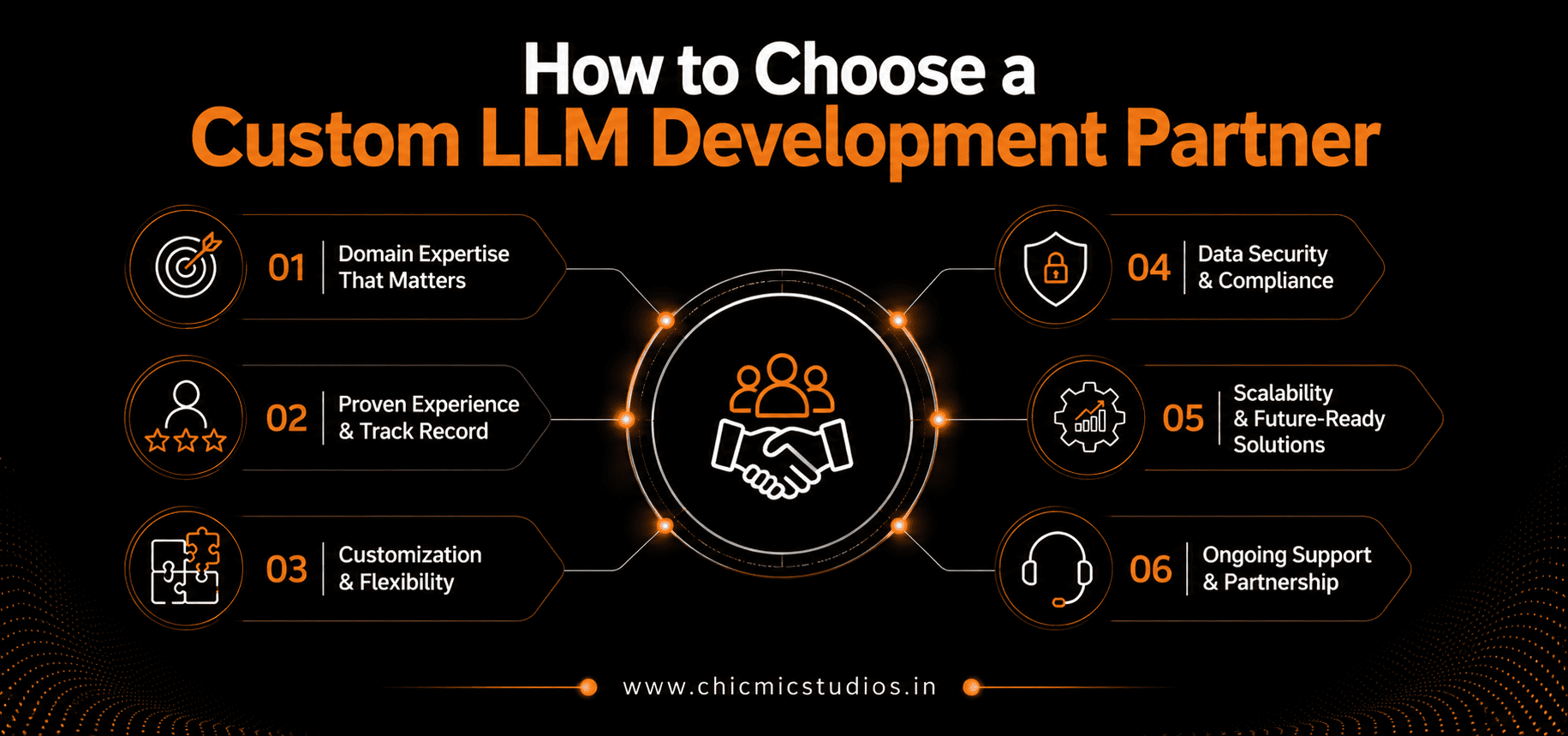
Important parameters for assessment are:
- Vertical Expertise
Find a partner with experience in your industry; finance, healthcare, legal, e-commerce, SaaS or business ops. Domain expertise informs model architecture, approaches to regulatory compliance, and workflow integration.
- Data Engineering Capability
Powerful LLM systems require data that is clean, curated, and consent-compliant. A reliable partner should possess the capabilities to prepare enterprise data for retrieval, optimization, assessment, and secure implementation.
- Security and Compliance Readiness
Ask about encryption, access control, audit logging, data privacy, deployment environments and compliance-driven development. This is particularly the case for regulated industries.
- Post-Deployment Support
Custom LLMs need ongoing monitoring, optimization, retraining and maintenance after they go live. Don’t engineer with partners that think deployment is the last step.
- Transparent Pricing and Delivery Roadmap
The partner should clearly specify the dates, scope, strategic model, infrastructure costs and ongoing maintenance obligations.
Key Warning: steer clear of “black box” vendors who do not explain how the model was trained, where data will be stored, how outputs will be evaluated, or what happens after the model is deployed. Good partners follow best practices for LLM development, offering clients transparency on design, data flows, risk management and performance indicators.
For organizations that need to build AI into their existing systems, working with LLM integration specialists means the solution will fit into real workflows, not just be a stand-alone demonstration.
Deployment & Integration Best Practices
LLM implementation and integration should be strategically planned from the start, not just a simple technical phase at the end. The model only has value to the corporation if it can be run safely within the current tools, procedures and decision-making frameworks that people use.
Best practices include:
- Use API-First Design
An API-first architecture means that the LLM can be integrated with CRMs, ERPs, helpdesk solutions, document platforms, mobile apps, online portals, and internal databases. Companies planning complex AI integrations can also review how a custom web app development agency supports backend architecture, API integration, scalability, and long-term product maintenance.
- Roll Out Gradually
Start with one department or workflow, and then scale it to the rest of the organization. Phased implementation allows teams to test for accuracy, acceptance, security and ROI before proceeding further.
- Keep Humans in the Loop
For high-risk tasks, human review should still be part of the workflow. This is particularly critical in industries like healthcare, finance, legal, insurance, and operations with stringent compliance requirements.
- Monitor for Model Drift
With time business data, policies, goods and regulations change. Surveillance allows for the identification of out-of-date answers, drops in accuracy, or changes in behavior.
- Build Feedback Loops
Model improvement over time is facilitated by user input, endorsement indicators, rectification data, and performance analytics. This makes deployment a continuous optimization loop.
- Strengthen the Data Layer
Reliable LLM output requires clean, fresh and well-controlled data. Data engineering investments for AI provide better retrieval accuracy, permission management and performance over time.
For production environments, scalable LLM solutions require observability, security measures, cost monitoring, contingency mechanisms, and ownership. Best practices for secure model deployment should follow existing AI governance and security frameworks such as the NIST AI Risk Management Framework, the OWASP Foundation’s application security guidance, and the Stanford HAI AI Index.
Get a Free AI Development Consultation – Schedule a no-obligation session to map out your custom LLM roadmap with our architects.
Future of Custom LLM Development
Looking ahead, custom LLM development is trending toward AI systems that are more autonomous, private, and integrated into workflows. From 2026, enterprise LLM customisation will focus on models that understand business context, take action, learn continuously and work safely in enterprise environments.
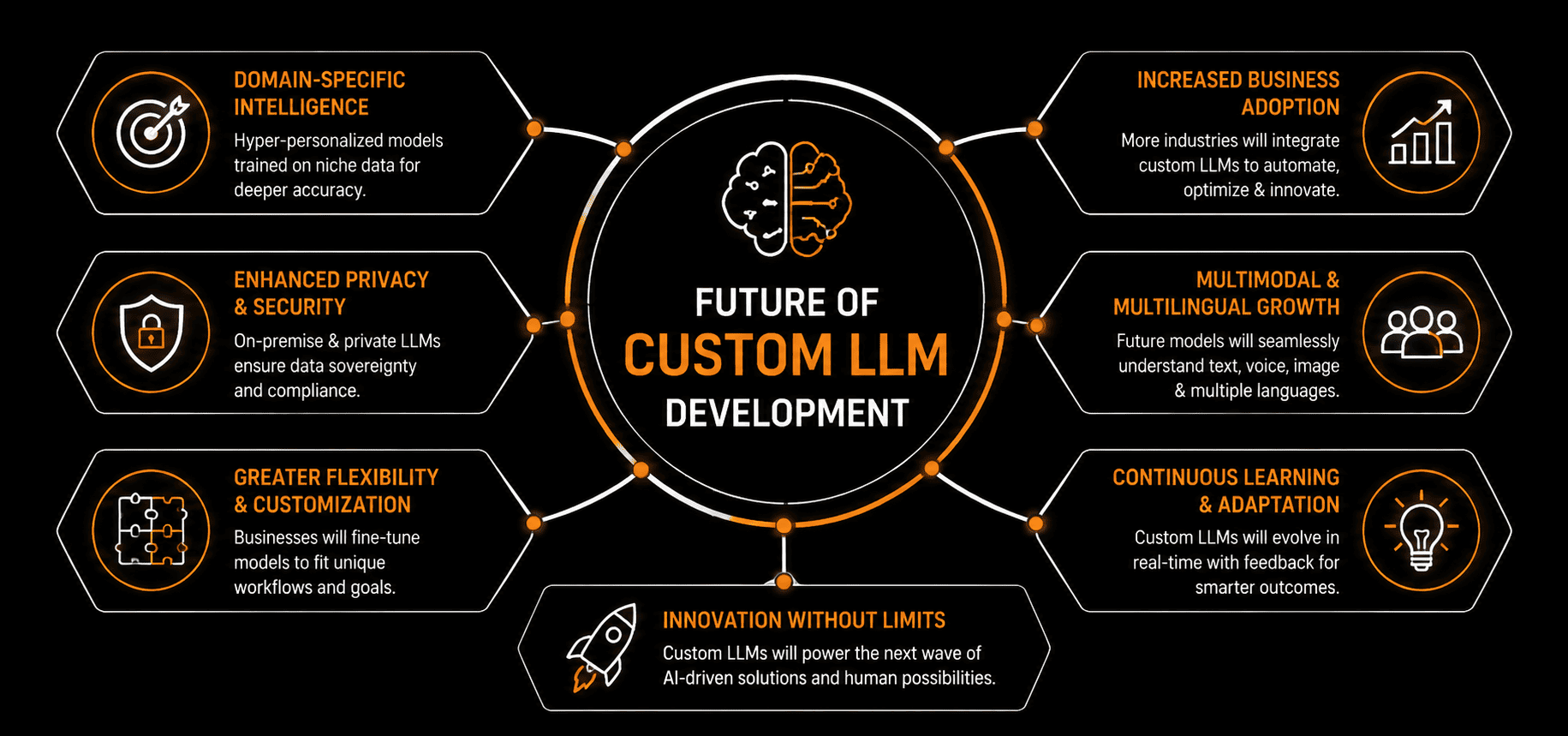
- Agentic AI Workflows
Large Language Models will graduate from answering questions to coordinating actions in Customer Relationship Management platforms, help desk tools, databases, and internal infrastructures. This speeds up execution and reduces the need for manual work.
- Small Proprietary LLMs for On-Device Deployment
Smaller proprietary LLM models will enable faster responses, lower cloud costs, better privacy, and offline use in mobile, healthcare, finance, and field operations.
- Custom LLMs with Multi Modalities
Custom LLMs will be trained on text, photos, speech, documents, charts and structured data simultaneously, powering more complex use cases in healthcare, e-commerce, legal and enterprise support.
- Continuous Fine-Tuning Pipelines
Organizations will use sanctioned comments, updated documents, resolved tickets and policy revisions to keep the model accurate over time. Today, cloud companies provide specialised infrastructure for fine-tuning.
- Federated Learning for Privacy-Preserving AI
Federated learning is a good fit for finance, healthcare, insurance and regulated industries because it allows you to improve your models without exposing sensitive data.
Enterprises exploring autonomous AI systems can also evaluate AI agent development services to understand what to look for before building agent-based workflows.
Talk to Our AI Strategy Experts – Ready to scale? Let’s discuss how enterprise LLM customization future-proofs your workflows.
Frequently Asked Questions
1. What is custom LLM development?
Custom LLM development refers to the process of building, fine-tuning, deploying and optimizing an LLM for a specific business use case. it creates a more precise and relevant AI system using company data, workflows, industry-specific language and security rules.
2. How much does custom LLM development cost?
A small proof of concept in 2026 might cost $25k – $75k depending on scope and availability of data. Considering extensive interconnections, private deployment and ongoing optimization, a full-scale production-grade business LLM system could cost from $150,000 to well over $500,000.
3. What industries use custom LLMs?
Custom LLMs in Finance Healthcare Legal e-Commerce Insurance SaaS Customer Service & Enterprise Operations They are especially useful in fields with sensitive information, complex techniques, domain expertise, and legal compliance.
4. How long does it take to build a custom LLM?
Full proof of concept is 6-10 weeks. A large enterprise deployment of data prep, integrations, security, testing and monitoring can take 3-6 months or more.
5. Can custom LLMs be integrated with existing systems?
Custom LLMs can integrate with CRMs, ERPs, helpdesk systems, document repositories, internal databases, APIs, mobile applications and the web. That’s true. That means the model might get plugged into existing company procedures, not a standalone chatbot.
6. What’s the difference between custom and generic LLMs?
A generic LLM can serve a variety of use cases, but a custom LLM is built to a company’s data, workflows, brand voice and compliance needs. Custom LLMs provide better domain accuracy, privacy, workflow automation and long-term competitive advantage.
7. Is custom LLM development secure?
Custom LLM can be secure when built with private deployment, encryption, role-based access, audit logs, guardrails and human review. Security is a function of architecture, data governance model, vendor practices, and vigilance.
8. What are common use cases for custom LLMs?
Common use cases include customer support automation, internal knowledge search, legal document review, financial analysis, healthcare intake, compliance monitoring, sales enablement and e-commerce customisation. The best use cases are those with business outcomes that can be measured.
9. How soon can enterprises see ROI from a custom LLM?
Companies that use the LLM to perform high-volume activities such as assistance, document review, reporting or knowledge search typically realize ROI within months. ROI depends on acceptance, level of automation, complexity and cost of existing manual operations.
10. What team is needed to build and manage a custom LLM?
A good bespoke LLM project usually involves AI engineers, data engineers, cloud architects, security specialists, product owners and domain specialists. After the implementation, teams have to be monitored, feedback has to be managed, retraining has to be supported and governance has to be controlled.